
If you live in Massachusetts and use kratom regularly, today may feel very different than it did yesterday.
As of August 28, 2026, Massachusetts has temporarily placed all forms of kratom into Schedule I under state law. The order can remain in effect for up to one year. Massachusetts says Schedule I substances are illegal to possess, distribute, or manufacture. Massachusetts Government
For someone who occasionally bought kratom at a smoke shop, that may simply mean the product disappears from the shelf.
But if you’re dependent on kratom, that’s not really the problem.
The problem is:
What am I supposed to do now?
I understand that question because I’ve been there.
I was brutally addicted to kratom myself. It wasn’t some abstract “substance use” problem I read about in a textbook. Kratom became woven into my days, my routines, how I felt, and eventually what I needed just to feel normal.
I also know what it’s like to desperately want to get off of it and discover that wanting to quit and actually staying quit are two very different things.
So if the Massachusetts ban has suddenly forced this issue for you, this isn’t going to be another article telling you that kratom is bad and that you should stop taking it.
You probably already know why you’re here.
Let’s talk about what comes next.
What Actually Changed in Massachusetts?
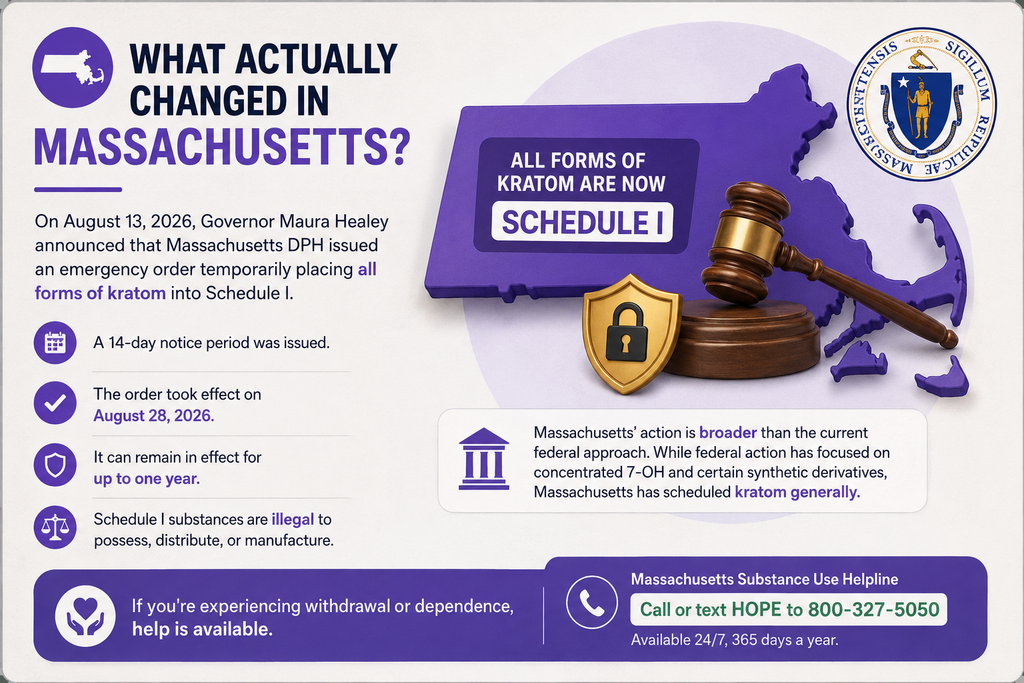
On August 13, Governor Maura Healey announced that the Massachusetts Department of Public Health had issued an emergency order temporarily placing all forms of kratom into Schedule I.
Following a 14-day notice period, that order took effect on August 28, 2026. Massachusetts Government
This distinction matters because there’s a lot of confusing information floating around right now about kratom, 7-OH, and the DEA.
The Massachusetts action is broader than the current federal approach.
At the federal level, recent scheduling actions have focused on concentrated 7-OH and certain synthetic kratom derivatives while exempting natural kratom leaf containing trace amounts of 7-OH. Massachusetts has instead temporarily scheduled kratom generally. Massachusetts Government
So if you’re reading older articles saying traditional kratom powder is still legal, understand that those articles may be talking about federal law or another state.
If you’re in Massachusetts, the situation changed on August 28.
If You’re Dependent on Kratom, This Isn’t Just a Legal Change
This is the part that’s easy to miss when kratom regulation becomes a news story.
There are real people behind it who may wake up and realize the substance their body has adapted to is suddenly much harder—or illegal—to obtain.
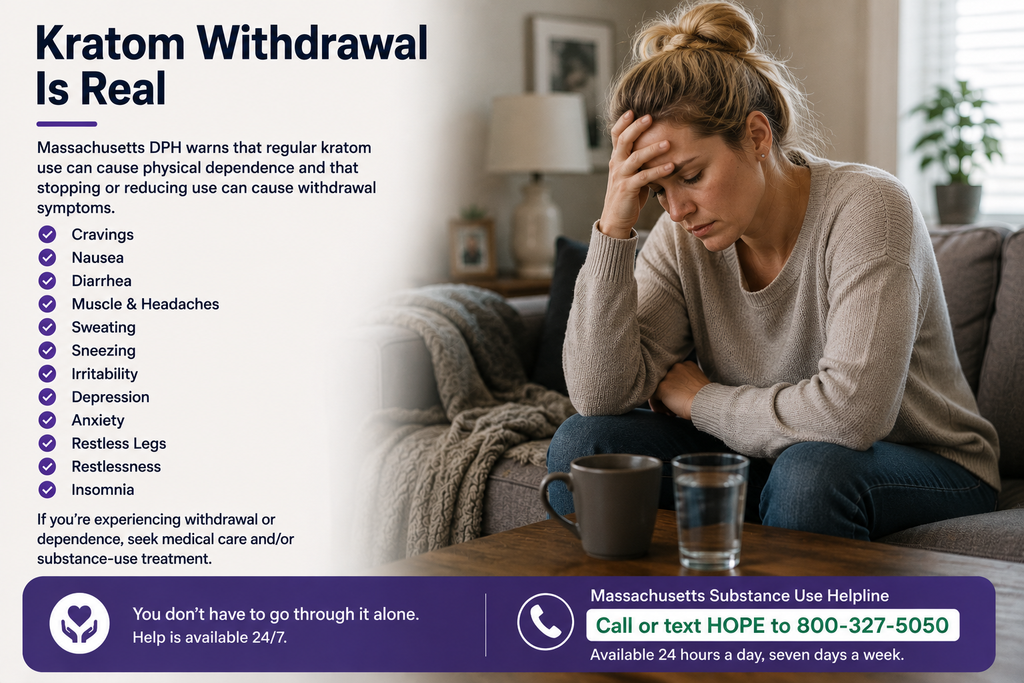
Massachusetts DPH specifically warns that regular kratom use can cause physical dependence and that stopping or reducing use can produce withdrawal symptoms including cravings, nausea, diarrhea, muscle and headaches, sweating, sneezing, and irritability. The state is advising people experiencing withdrawal or dependence to seek medical care and/or substance-use treatment. Massachusetts Government
I don’t need a government document to tell me kratom withdrawal is real.
I’ve lived it.
When I finally quit, the first several days were brutal.
The restless legs were one of the worst parts for me. And it wasn’t only my legs—I could feel that horrible restlessness through my body. Sleep fell apart. I had aches, emotional crashes, and this awful feeling that something was missing.
There were moments where taking kratom again would have solved the immediate problem almost instantly.
That’s what makes withdrawal so deceptive.
The thing causing the problem is also the thing your brain knows can temporarily make the problem disappear.
If you’ve been using kratom every day, don’t underestimate that dynamic.
First: Get Honest About Where You Are
Before worrying about the next six months, figure out where you actually stand today.
How much kratom are you taking?
How many times per day?
Are you using powder, capsules, extracts, 7-OH, or multiple products?
How long have you been using regularly?
Do you wake up needing it?
Do you experience withdrawal between doses?
Have you tried quitting before?
What happened when you did?
You don’t need to judge any of the answers.
You need accurate information.
I spent a long time knowing on some level that kratom had become a problem while still finding ways to negotiate with myself about exactly how much of a problem it was.
Eventually there wasn’t much left to debate.
I wasn’t really using kratom anymore because it was making my life dramatically better.
I was using it because not using it felt worse.
That’s a very different relationship with a substance.
Decide Whether You Need Medical Help
There isn’t one universal kratom withdrawal experience.
Someone taking a relatively small amount of traditional powder may have a very different experience from someone using high-potency extracts or concentrated 7-OH products throughout the day.
Duration of use matters. Dose matters. Other medications and substances matter. Your health matters.
If you’re heavily dependent, have had severe withdrawal before, use other substances, or simply aren’t sure whether stopping on your own is appropriate, talk to a healthcare professional.
Massachusetts says existing substance-use programs can help people experiencing kratom withdrawal and dependence through medications, counseling, peer support, and behavioral-health services. The Massachusetts Substance Use Helpline is available 24/7 by calling or texting HOPE to 800-327-5050. Massachusetts Government
Getting help doesn’t mean your situation has to be catastrophic.
It means you’re using the resources available to you.
I’ve been where you are. Let me help.
I’ve been through this myself. These are the emails I wish I had when I was trying to quit — things that helped me through the hard days, lessons I learned the hard way, and what finally helped me get free and stop going back.
No spam. Just real emails from someone who’s been there.

Don’t Let the Ban Turn Into Panic
When access to something you’re dependent on suddenly becomes uncertain, your brain may immediately go into scarcity mode.
I need to stock up.
Maybe I can order it somewhere else.
Maybe I’ll switch products.
I’ll quit later.
This is terrible timing.
I understand the impulse.
But if you’ve already spent months—or years—telling yourself you’re eventually going to quit, it’s worth recognizing what’s happening.
You’re being presented with another opportunity to delay the decision.
I did plenty of delaying myself.
There was always another reason why right now wasn’t the ideal time.
Work was stressful.
Sleep might be bad.
I had things to do.
Maybe I’d reduce my dose first.
Maybe I’d quit next week.
Maybe I’d find a better method.
At some point I had to stop waiting for quitting to become convenient.
It never did.
The Massachusetts ban may have chosen the timing for you in a way you didn’t expect. But if you already know you don’t want kratom controlling your life anymore, you can still choose what this moment means.
The First Few Days Can Be Rough
For many people, the immediate concern is simply getting through withdrawal.
That’s understandable.
When I quit, there wasn’t anything philosophical about lying awake unable to sleep or dealing with relentless restlessness. I just wanted it to stop.
And when you’re exhausted enough, your thinking changes.
One more dose starts sounding reasonable.
Starting over tomorrow sounds reasonable.
You remember the relief kratom provided much more vividly than you remember why you wanted to quit.
That’s why I’d prepare for those first days instead of assuming you’ll simply overpower them when they arrive.
Make your life easier where you reasonably can.
Give yourself room to sleep poorly.
Eat.
Stay hydrated.
Move your body if you’re able.
Have someone you can contact.
Know beforehand what you’re going to do when the thought of using shows up.
And seek medical care if your symptoms are severe, concerning, or you’re unsure how to handle them.
But there’s something else I wish more people talked about.
Getting through withdrawal is not the same thing as recovering.
The Part After Withdrawal Is Where I Kept Getting Stuck
This became one of the biggest lessons of my own recovery.
I could stop taking kratom.
I could suffer through withdrawal.
I could put days between myself and my last dose.
And I could still eventually go back.
Why?
Because getting kratom out of my body didn’t automatically change my relationship with kratom.
Somewhere underneath everything, I still believed it gave me something.
Relief.
A reward.
Something to look forward to.
A way to change how I felt.
A way to make ordinary life feel different.
So eventually there would be a difficult day, a boring night, stress, loneliness, or simply enough distance from the misery of withdrawal that my memory started becoming selective.
The bad parts faded.
The fantasy came back.
Maybe this time I can control it.
Maybe once won’t matter.
Maybe I made too big a deal out of it.
That’s the cycle I eventually realized I had to break.
Not just:
How do I stop taking kratom?
But:
How do I stop wanting to go back?
Those are different problems.
Ask Yourself What Kratom Was Actually Doing for You
One of the most useful questions I eventually had to confront was:
What did I believe kratom was giving me?
Not what mitragynine was doing at a receptor.
What did kratom mean to me?
Maybe for you it was energy.
Maybe work felt easier after taking it.
Maybe it helped with pain.
Maybe evenings felt better.
Maybe you used it when you were lonely.
Maybe you liked having something to look forward to.
Maybe you couldn’t imagine relaxing without it.
Maybe it became the little reward waiting for you after dealing with everything else.
Those associations don’t disappear simply because Massachusetts changed the law.
And if you never examine them, the risk is that you spend recovery feeling deprived.
You aren’t taking kratom, but part of you still believes:
Life would be better if I could.
That’s a miserable place to stay.
You Have to Start Changing the Pattern, Not Just Removing the Substance
This is where my understanding of recovery changed.
I stopped seeing the problem as purely one of self-control.
Repeated behaviors become learned patterns.
Situations become associated with using.
Thoughts trigger cravings.
Cravings trigger familiar responses.
Your brain learns:
When X happens, kratom follows.
Recovery means interrupting those patterns repeatedly and building different ones.
It means learning to recognize the thought that precedes the behavior.
It means seeing the old argument before automatically believing it.
It means changing what you do when you’re stressed, bored, exhausted, lonely, or craving relief.
And over time, the old pathway doesn’t have to remain the default.
This is one reason K-Free is built around behavior change and neuroscience, rather than functioning as another sobriety counter.
Counting days can be useful.
But the number isn’t what keeps you free.
What matters is what changes during those days.
Build a Life You Don’t Constantly Need to Escape From
Eventually, recovery becomes less about kratom.
That was important for me.
I didn’t want to spend the rest of my life waking up every morning thinking about how successfully I had avoided kratom yesterday.
I wanted kratom to become irrelevant.
That meant rebuilding ordinary life.
Exercise.
Sleep.
Routine.
Taking care of myself.
Learning to tolerate boredom.
Finding things I actually wanted to do.
Understanding my own triggers.
Learning that every uncomfortable feeling didn’t need to be chemically changed.
And accepting that sometimes life is simply ordinary.
That’s a much bigger project than detox.
But it’s also where freedom actually starts.
I don’t think the goal should be:
“I desperately want kratom, but I’m strong enough to resist it.”
The better goal is getting to a point where you genuinely understand why you left it behind.
Where the fantasy has lost its power.
Where you don’t feel like you’re sacrificing something every day by staying free.
The Ban Can Be the Beginning of Something Better
If you’re angry about the Massachusetts ban, I understand that too.
Maybe you didn’t intend to quit.
Maybe you planned to quit eventually but wanted to do it on your own schedule.
Maybe you’ve been using kratom for years and suddenly feel like something you’ve structured your life around is being taken away.
I’m not going to tell you how you’re supposed to feel about the law.
But I would tell you this:
You still get to decide what happens next.
If kratom had already become something you were tired of needing, this can be the point where the relationship ends.
Not because Massachusetts made some profound personal decision for you.
Because you decided to use the moment.
Instead of:
Massachusetts took kratom away from me.
Maybe eventually the story becomes:
That was when I finally got free.
K-Free Was Built for the Part That Comes Next
I built K-Free because I couldn’t find what I needed when I was trying to get off kratom.
There were counters.
There were forums.
There was generic addiction content.
But I wanted something specifically built around the reality of quitting kratom and actually staying off it.
K-Free is designed for people who are preparing to quit, people in the early days, and people who already stopped but need support staying free.
The program uses behavior-change principles, recovery frameworks, and neuroscience-informed education to help you understand the patterns behind your use and build the skills to change them.
There are daily recovery programs, craving tools, guided exercises, meditations, progress tracking, community support, and tools for the moments when going back suddenly sounds like a good idea.
Because ultimately, I didn’t build K-Free to help someone stare at a counter for the rest of their life.
I built it to help people build a life where kratom doesn’t have to be part of it anymore.
Massachusetts Kratom Withdrawal and Treatment Resources
Massachusetts is specifically directing residents experiencing kratom withdrawal or dependence toward its existing substance-use treatment system.
The state says available treatment can include medications, counseling, peer support, and behavioral-health services. Massachusetts Government
The Massachusetts Substance Use Helpline is available 24 hours a day, seven days a week.
Call or text: HOPE to 800-327-5050
Massachusetts DPH also has dedicated kratom information covering health risks, overdose response, treatment, and recovery resources. Massachusetts Government
If you’re experiencing a medical emergency or severe symptoms, seek emergency medical care.
Frequently Asked Questions
Is kratom banned in Massachusetts in 2026?
Yes. Massachusetts temporarily placed all forms of kratom into Schedule I effective August 28, 2026. The emergency order can remain in effect for up to one year. Massachusetts Government
Does the Massachusetts kratom ban only apply to 7-OH?
No.
This is an important distinction. The Massachusetts emergency order applies to all forms of kratom, rather than only concentrated 7-OH products. Massachusetts Government
Is possessing kratom illegal in Massachusetts now?
Massachusetts states that Schedule I controlled substances are illegal to possess, distribute, or manufacture, and the August 28 order temporarily places all forms of kratom into Schedule I. Massachusetts Government
Is kratom federally banned too?
No. The Massachusetts action should not be confused with federal regulation.
Massachusetts’ August 28 announcement notes that federal action has targeted concentrated 7-OH and certain synthetic kratom derivatives while natural kratom leaf containing trace 7-OH remains exempt federally. Massachusetts Government
What should I do if I’m physically dependent on kratom?
If you’re concerned about withdrawal, particularly if you use heavily, use high-potency products, take other substances or medications, have underlying health conditions, or have experienced difficult withdrawal before, consider talking with a healthcare professional.
Massachusetts DPH specifically recommends medical care and/or substance-use treatment for people experiencing kratom withdrawal and dependence. Massachusetts Government
What if I’ve already quit kratom?
Then the Massachusetts ban doesn’t necessarily solve your problem.
If you’ve already stopped but still experience cravings, romanticize using again, or keep finding yourself returning to kratom, the work becomes learning how to stay free.
That’s the part of recovery I eventually realized mattered most.
Withdrawal ends.
The goal is making sure the cycle ends with it.
Sources
Massachusetts Governor’s Office & Department of Public Health. “Reminder: Governor Healey’s Order Protecting Massachusetts Residents from Dangerous Kratom Products Goes into Effect Today.” August 28, 2026.
Massachusetts Governor’s Office & Department of Public Health. “Governor Healey Takes Action to Protect Young People and Residents from Dangerous Kratom Products.” August 13, 2026.
Massachusetts Department of Public Health. “Kratom.” August 2026.
Massachusetts Department of Public Health. “Kratom Work Aid for Boards of Health.” August 13, 2026.

Alex Stone
Writes about kratom and 7-OH for K-Free.