
If you’re searching for 7-OH withdrawal, there’s a decent chance you already know something has changed.
Maybe the tablets don’t really get you where they used to. Maybe you’re dosing more often. Maybe you wake up uncomfortable and the first thing on your mind is taking enough to feel normal again.
Or maybe you tried to stop, made it several hours, and realized very quickly that this wasn’t going to feel like skipping coffee for a few days.
That moment can be unsettling.
I remember my own version of it with kratom. There was a point where I had to stop pretending I was deciding whether to use. My day was increasingly being organized around what happened if I didn’t.
I didn’t personally quit concentrated 7-OH, and I’m not going to pretend that I did. My experience was with kratom. But the recovery pattern underneath dependence is familiar to me, and we now have enough clinical evidence to say something clearly that people using these newer products deserve to hear:
7-OH withdrawal is real.
The FDA reports withdrawal symptoms associated with 7-OH products including restlessness, body aches, fatigue, irritability, and cold sweats. Medical literature now also documents acute opioid-like withdrawal following heavy concentrated 7-OH use.
The science specifically studying human 7-OH withdrawal is still young, though.
So I’m going to do something I wish more withdrawal guides did: separate what we actually know from what people on the internet have repeated enough times that it starts sounding like established fact.
Here’s the map we have right now.
What is 7-OH withdrawal?
7-OH is short for 7-hydroxymitragynine, an alkaloid associated with the kratom plant.
That description can make modern 7-OH products sound like they’re basically concentrated kratom.
That’s not a particularly useful way to think about them.
Traditional kratom leaf naturally contains 7-OH in trace amounts. The products now marketed specifically around 7-OH — tablets, gummies, shots, drink mixes, and similar formulations — can contain added or enhanced levels of it. The FDA explicitly distinguishes these concentrated products from the trace quantities naturally occurring in botanical kratom.
7-OH also has substantial activity at mu-opioid receptors. The FDA’s scientific assessment characterizes its pharmacology as predominantly mu-opioid agonist and notes substantially greater mu-opioid receptor potency than mitragynine, kratom’s primary alkaloid.
With repeated exposure, your nervous system can adapt to that signal.
Eventually taking 7-OH isn’t simply producing an effect anymore. It’s also preventing the uncomfortable state that appears when the effect disappears.
That’s physical dependence.
And there’s a transition here worth noticing.
Early on, you may take something because you want to change how you feel.
Later, you may find yourself taking it because you’re afraid of how you’ll feel without it.
Those two situations can look identical from the outside.
They feel very different when you’re living them.
What does 7-OH withdrawal feel like?
Published clinical reports describe 7-OH withdrawal with opioid-like features.
Reported symptoms have included:
- Restlessness
- Anxiety
- Insomnia
- Muscle aches
- Abdominal cramping
- Nausea
- Diarrhea and other gastrointestinal symptoms
- Chills or sweating
- Irritability
- Difficulty concentrating
- Strong cravings
One important limitation: we still don’t have large human studies establishing exactly how frequently each symptom occurs in people quitting 7-OH.
Much of the clinical literature consists of case reports involving individual patients, sometimes with other substance use involved. That’s useful evidence that these withdrawal syndromes occur, but it isn’t enough to turn somebody else’s experience into a promise about yours.
The symptom I think deserves particular attention is restlessness.
Anyone who has experienced substance withdrawal knows that “restless” can be an almost comically inadequate word for it.
It’s not simply being bored.
Your body won’t settle. You lie down and need to move. You move and don’t feel better. You change positions. You walk around. You get back into bed.
Five minutes later you’re moving again.
Then you add insomnia.
One bad night becomes two. The hours start moving incredibly slowly. You’re exhausted but can’t comfortably stay still long enough to sleep.
Sleep tends to be the slowest part of this to come back, whatever you were taking. How long kratom withdrawal insomnia lasts covers why it lags behind the physical symptoms, and what the small hours do to your thinking.
And somewhere nearby is the thing that you know could make all of it stop.
That’s where withdrawal becomes more than a collection of symptoms.
I’ve been where you are. Let me help.
I’ve been through this myself. These are the emails I wish I had when I was trying to quit — things that helped me through the hard days, lessons I learned the hard way, and what finally helped me get free and stop going back.
No spam. Just real emails from someone who’s been there.

How soon does 7-OH withdrawal start?
This is where I want to be careful.
There is currently no scientifically established hour-by-hour 7-OH withdrawal timeline that applies to everyone.
You’ll find very specific schedules online:
Six hours: this happens.
Twelve hours: this happens.
Day three: peak.
Day seven: you’re fine.
We don’t have the human research to be that confident yet.
How quickly symptoms appear can vary with how much you’re using, how frequently you’re dosing, the potency and composition of the product, how long you’ve been using it, and your individual physiology.
Heavy dependence can also create another pattern: withdrawal beginning between doses.
That’s an important moment.
You aren’t waiting until you decide to quit anymore.
Your body is already showing you what happens when the interval gets too long.
If you’re redosing mainly because discomfort is beginning to creep in, that’s useful information about where your relationship with 7-OH has gotten to.
How long does 7-OH withdrawal last?
There isn’t yet enough 7-OH-specific clinical research to give everyone a reliable number.
And I know that’s an annoying answer.
When you’re about to quit, you don’t want someone telling you it varies.
You want to know which morning you’re going to wake up and feel normal again.
I wanted the same thing.
But I think there’s a more useful way to understand what’s ahead than obsessing over exactly which hour you’re on.
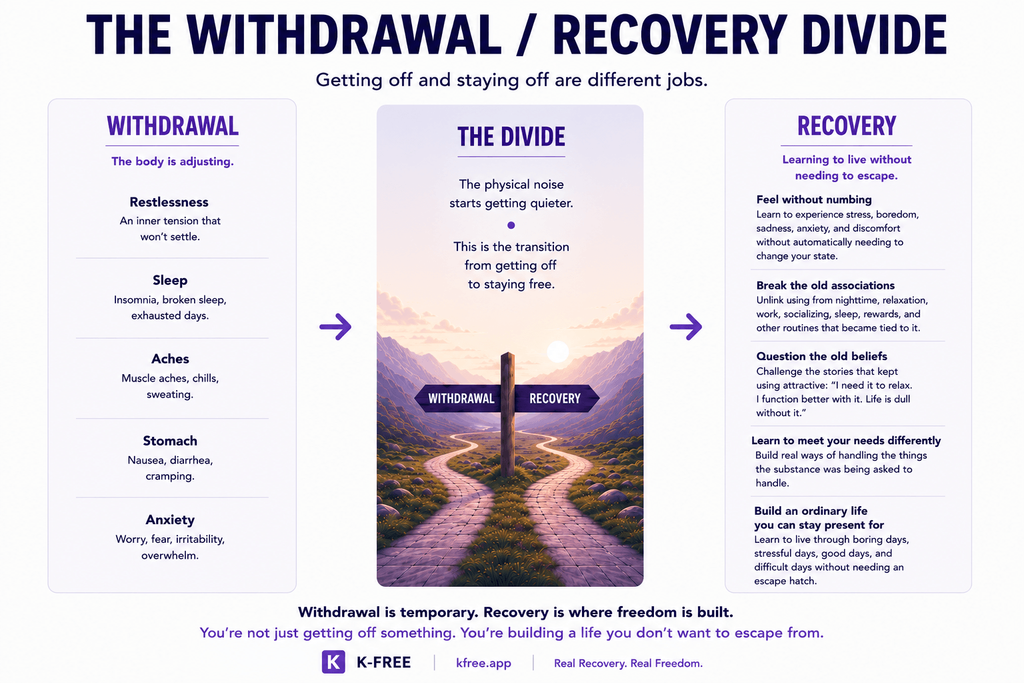
There are actually two different jobs happening here.
I call this the Withdrawal / Recovery Divide.
We go deeper on what does and doesn’t change over time in the 7-OH withdrawal timeline.
Job one: getting through withdrawal
This is the immediate physical adjustment.
Your body is trying to function without a signal it adapted to receiving regularly.
This is the stage dominated by things like restlessness, stomach problems, aches, sweating, anxiety, disrupted sleep, and the immediate urge to make the discomfort stop.
During this period, the goal can become very small.
Get through tonight.
Get through this wave.
Don’t turn fifteen horrible minutes into another month of using.
Eventually the acute physical intensity comes down.
Job two: learning how to stay free
This job is quieter.
And in my experience, it’s the one that gets underestimated.
You start sleeping again.
Food tastes normal.
Your body stops demanding your attention every second.
You would think that means you’re safe.
Sometimes that’s exactly when a different problem begins.
The memory of how bad withdrawal felt starts fading while the memory of relief stays strangely available.
And your mind starts talking.
I know what I did wrong last time.
I could keep it under control now.
Just tonight.
Only on weekends.
I’m not going back to daily use.
Those don’t always feel like cravings.
They can feel like conclusions.
That’s why I think of them as cravings disguised as arguments.
The acute withdrawal tells you plainly what it wants.
Later cravings sometimes try to convince you that using again was your idea.
Learning to recognize that shift is part of recovery.
Is 7-OH withdrawal worse than kratom withdrawal?
It can be.
But I wouldn’t turn that into a universal rule.
Traditional kratom use varies enormously. So does concentrated 7-OH use.
What we can say confidently is that concentrated 7-OH products and traditional kratom leaf are not equivalent exposures.
Traditional botanical kratom contains numerous alkaloids, with mitragynine generally being the predominant one. Naturally occurring 7-OH is present at much lower levels.
Commercial products designed specifically around 7-OH can contain added or enhanced 7-OH instead.
That distinction is significant enough that federal regulators themselves make it. The FDA’s current warning specifically targets products containing 7-OH as an added ingredient or at enhanced levels rather than the trace amount naturally occurring in kratom. The DEA’s July 2026 action similarly targets 7-OH above a specified threshold and says botanical kratom containing naturally occurring 7-OH below that threshold is outside the action.
So if you’ve previously stopped powder and assume you already know exactly what stopping a concentrated 7-OH product will be like, I wouldn’t rely too heavily on that assumption.
They’re related.
They’re not interchangeable.
How do I know if I’m dependent on 7-OH?
Forget the label for a minute and look at the pattern.
Are you taking more than you originally planned?
Are your doses getting closer together?
Do you start feeling physically uncomfortable when you go too long without it?
Are you taking it to feel good — or increasingly taking it just to stop feeling bad?
Have you made rules about how you’re going to use and repeatedly broken your own rules?
Does running out create anxiety?
Do you find yourself organizing errands, work, sleep, or travel around making sure you have enough?
Have you genuinely wanted to stop and discovered that wanting to stop wasn’t enough?
You don’t need every one of those to prove something.
The point is to look at your situation without negotiating with it.
There’s an enormous difference between:
This is something I enjoy taking.
and:
My day works differently when I don’t have this.
If you’ve crossed that line, knowing it gives you somewhere to start.
Should I taper 7-OH or quit cold turkey?
This is one area where I’m not going to pretend a blog post should replace individualized medical advice.
People stop substances in different ways, but concentrated 7-OH products, usage levels, and health circumstances vary too much for me to hand strangers a universal dosing schedule and call it responsible.
If you’re using heavily, have previously experienced significant withdrawal, use other substances or medications, or you’re uncertain about stopping safely, talking with a clinician is worth considering.
And there is now actual clinical precedent for doing that.
Recent medical literature includes both outpatient and inpatient cases involving medically managed 7-OH withdrawal.
Getting medical help doesn’t somehow make the quit less legitimate.
The objective isn’t to win an award for suffering.
The objective is to get free.
If you’re leaning toward tapering, how to taper off 7-OH covers how people build one and the reason most of them stall.
And if you haven’t settled on a route yet, how to get off 7-OH lays out the three ways people do it and how they choose between them.
When should I seek medical help?
There’s ordinary withdrawal misery, and then there are situations that shouldn’t be managed by reading another article.
Repeated vomiting or diarrhea can lead to dehydration. Other substances can complicate withdrawal. Significant medical conditions can change what is safe.
If you’re experiencing severe or rapidly worsening symptoms, significant dehydration, severe confusion, chest pain, fainting, difficulty breathing, or another symptom that feels medically serious, get evaluated.
And if your use is heavy enough that you’re genuinely unsure whether you can stop safely, that’s itself a reasonable reason to talk with a healthcare professional before doing it.
The part of withdrawal I wish I understood earlier
When I was quitting kratom, I thought freedom lived on the other side of the physical symptoms.
Get through the bad nights.
Get through the restless legs.
Get through the sadness and the weird emptiness.
Then you’re done.
I don’t see it that way anymore.
Withdrawal was the price of getting the substance out of the immediate equation.
Recovery was learning why I kept wanting to put it back.
That’s a much more interesting problem.
Because eventually you’re not fighting diarrhea or restless legs.
You’re having a perfectly normal Tuesday.
Work was annoying.
You didn’t sleep well.
Nothing particularly interesting is happening tonight.
And somewhere in your mind appears the memory of how easy it would be to change the way the evening feels.
That’s the moment recovery has to be built for.
Not just the dramatic moments.
The ordinary ones.
I think this is one of the biggest mistakes we make when talking about quitting substances.
We build everything around the crisis.
The withdrawal.
The desperate decision.
The awful night.
The flushed stash.
The first clean day.
But most of your future life isn’t going to happen in crisis.
It’s going to happen while you’re bored.
Or tired.
Or disappointed.
Or celebrating.
Or sitting at home on a Friday night with absolutely nothing wrong.
If your entire recovery strategy only works while you’re intensely motivated to quit, it has a built-in expiration date.
Eventually life becomes ordinary again.
And that’s good.
But your recovery has to know how to live there too.
You don’t actually want to become better at resisting 7-OH
There’s another distinction that matters to me.
The goal isn’t to spend the rest of your life heroically resisting something you desperately want.
That still leaves the substance sitting in the middle of your psychological world.
You’re just saying no to it every day.
Real freedom is quieter than that.
You start examining what you actually believed the substance was doing for you.
What problem did it seem to solve?
What feeling did it seem to remove?
What part of your day did it make easier?
What story do you tell yourself when you remember using?
And is that story still true when you remember the whole experience rather than the first thirty minutes?
That’s where the relationship starts changing.
The argument loses some of its force.
The feeling of deprivation starts disappearing.
You stop romanticizing what using actually became.
And slowly, the thing that once organized your day becomes something you simply don’t do anymore.
That’s a very different kind of freedom from counting hours since your last dose.
It’s the one worth building toward.
What is happening with 7-OH legally?
The environment around concentrated 7-OH is changing quickly.
The FDA has been taking enforcement action against added and enhanced 7-OH products since 2025, including warning letters and a December 2025 seizure of roughly 73,000 units of concentrated 7-OH products.
Then, in July 2026, the DEA published its intent to temporarily place 7-OH above a specified threshold and three related substances into Schedule I.
Importantly, this particular action does not target botanical kratom products containing naturally occurring 7-OH below the specified threshold.
For someone currently dependent on concentrated 7-OH, the practical point is simpler:
The market around the substance you’re using may look very different soon.
If you’ve already been thinking about getting out, that’s worth knowing.
The part worth holding onto
If you’re sitting at that quiet decision point right now, there’s something I can tell you from the other side of my own version of this.
The terrible part feels permanent while you’re inside it.
It isn’t.
Neither is the strange period afterward where normal life doesn’t quite feel normal yet.
But don’t make the mistake I made of thinking the entire objective is reaching the day where withdrawal ends.
That’s only the first border.
What you’re actually building is a life where you don’t need to keep returning to the thing you fought so hard to leave.
Getting off and staying off are different jobs.
The first gets you out.
The second keeps you free.
And eventually, if you keep doing the work, there can come a point where being free doesn’t feel like something you’re constantly maintaining.
It’s simply your life again.
Frequently Asked Questions About 7-OH Withdrawal
Does 7-OH cause withdrawal?
Yes. The FDA reports withdrawal symptoms associated with 7-OH products, and published clinical cases document opioid-like withdrawal after cessation of heavy concentrated 7-OH use.
What are the symptoms of 7-OH withdrawal?
Reported symptoms include restlessness, anxiety, insomnia, muscle aches, nausea, diarrhea and other gastrointestinal symptoms, sweating, irritability, and cravings. The exact symptoms and severity vary between people.
How long does 7-OH withdrawal last?
There is not yet enough 7-OH-specific human research to establish one reliable withdrawal duration for everyone. Usage level, frequency, product potency, duration of use, and individual physiology can affect the experience.
Is 7-OH withdrawal like opioid withdrawal?
It can be. 7-OH has mu-opioid receptor activity, and medical case reports have documented withdrawal syndromes with opioid-like features following heavy concentrated 7-OH use.
Is 7-OH the same as kratom?
No. 7-hydroxymitragynine occurs naturally in kratom at low levels. Modern products marketed specifically around 7-OH may contain added or enhanced concentrations and shouldn’t automatically be treated as equivalent to traditional botanical kratom leaf.
Can a doctor help with 7-OH withdrawal?
Yes. Published medical reports describe both outpatient and inpatient management of significant 7-OH withdrawal. The appropriate treatment depends on the individual.

Alex Stone
Writes about kratom and 7-OH for K-Free.